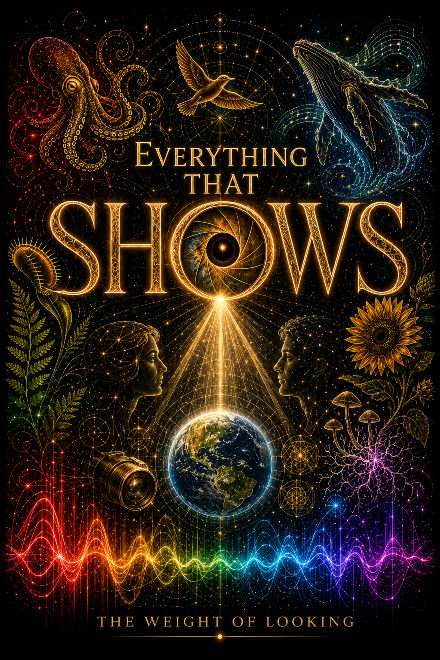
The ethics of perception
Everything That Shows
The Weight of Looking
A walk outward from your own eye to the octopus, the whale, the forest, the planet, and a machine — following one question the whole way: what do we owe the things we have only just learned to see?
The whole book, in your browser. No paywall, no sign-up. ·
Everything That Shows is a book about one quiet idea: to perceive a thing is already to take a kind of power over it.
Seeing feels like reception — the world arriving, whole, through an open window. It is closer to reduction. Out of an ocean of light your eye keeps a sliver and throws the rest away, then hands you the sliver as if it were everything. The color you see is not in the object; you manufacture it. And if perception is an act, then it is a moral one, and what we owe a thing begins at the moment we first make it out.
From your own eye the book walks outward — to the octopus and its mind grown in the arms, to whale song we swam over in silence for centuries, to plants and fungi that sense without a brain, to the whole Earth as one living process, and to a camera built to forget. It is written for the curious, not the credentialed. There is no prerequisite but attention, and it is here in full, free to read.
Questions you’ll get to live with
You don’t need the answers to begin — only the pull of the questions.
- Is the color you see out there in the world, or manufactured somewhere in you?
- Is the self behind your eyes a real watcher, or something the brain builds moment to moment?
- What do we owe a mind we can never get inside — an octopus, a whale, a stranger?
- Where do you actually end and the world begin, when even “one creature” is a line we draw?
- Should a powerful instrument sometimes choose, deliberately, to forget?
- If nothing has a standalone nature, what is left when you stop seeing things as separate?
Thirteen chapters, in seven parts
The book is one continuous walk outward, read from the beginning. Here is the path ahead.
Part I · The Instrument You Can’t Deny
- IThe Weight of LookingColor is not in the world — you manufacture it. Why perception is an act of reduction, and why that act is the first and most overlooked moral one.
- IIThe Edge You Can’t SeeSaccades, the blind spot, a thumbnail of sharp vision: the seams of seeing, and the danger of a partial picture that feels complete.
- IIIThe One Behind the EyesGo looking for the watcher behind your eyes and find no one there — only a self the brain builds, moment to moment, out of streams you cannot feel.
Part II · The First Crossing
- IVThe Sealed RoomThe problem of other minds: every other is a sealed room you meet only from the outside, and your model of them is never the person.
- VFrom Where They StandThe personal chapter — disability, perspective, and the dignity of a vantage you will never occupy.
Part III · Other Minds
- VIThe Second MindThe octopus: a complex mind grown on a separate branch of life, most of it in the arms — a second, independent answer to what it is to have an inside.
- VIIThe Silent WorldWhale song, and fifty years of learning to hear a structured, meaning-bearing music we had been swimming over in silence.
- VIIILearning to AnswerFrom listening to answering — animal communication, machine translation, and the Clever Hans warning against reading meaning into a response.
Part IV · The Faceless Living
- IXThe Lights Are OnThe Venus flytrap that counts, the slime mould that maps the shortest path: sensing and decision without a brain.
- XWhat Counts as OneFungi, mycelium, the microbiome: where one creature ends, and whether the edge of an individual is something we find or something we draw.
Part V · The One Body
- XIThe Whole EarthThe overview effect and Gaia: the planet as a single system that has, for four billion years, quietly kept itself alive.
Part VI · The Instruments We Make
- XIIThe WitnessA camera built to forget — on-device, signed, hash-chained, the footage discarded: the whole argument of the book made out of silicon.
Part VII · One Idea
- XIIINothing Is Itself AloneNāgārjuna, Rovelli, and Leopold meet: nothing has a standalone nature; the world is a web of relation, and so are we.
About
I am not a vision scientist or a philosopher by trade. I am someone who could never stop asking how the world works — and found, eventually, that the strangest part is the act of looking itself: how much we throw away to see at all, and how easily we mistake our sliver of the world for the whole of it. I wrote this book to follow that thought outward, from the human eye to the planet, and to argue that what we owe a thing begins the moment we first make it out.
— Karl Meves
Questions
Is the book really free?
Yes. The entire book is free to read online, with no paywall and no sign-up.
Can I share it?
Please do. Send the link to anyone who might be curious; sharing it is the whole point of keeping it free. The text stays the author’s own, so please point people to the book here rather than reposting it elsewhere, but the link is yours to spread as widely as you like.
Do I need an account?
No account, no email, nothing is collected. Just open it and read. Your place is remembered only in your own browser.
Can I read it offline?
Yes. The site is a Progressive Web App: once loaded it works offline, and you can install it to your phone or desktop home screen.
What is the book about?
In thirteen chapters it argues that to perceive a thing is to take a kind of power over it, and that what we owe it begins at the moment of seeing — walking outward from your own eye to the octopus, the whale, the forest, the planet, and a camera built to forget, threaded by the idea that nothing has a standalone nature.
How long is it?
Thirteen chapters, around four to five hours of reading in total, though it is built to be read in pieces. The book holds your place, so you can read a section at a sitting and come back whenever you like.
Who wrote it?
Karl Meves, who could never stop asking how the world works. The short version is in the foreword; the longer answer is the book.
Take it with you
Prefer your own reader, or want it offline on every device? Download the whole book as an ebook — the same text, free.
EPUB opens in Apple Books, Google Play Books, Kobo and most readers. The file is regenerated from the source and validated on every release.
Support the work
The book is free, and it will stay free. If reading it gave you something and you would like to give something back, you can support the work directly — or simply share it with someone curious. Either keeps it open for the next reader.
The series
The world that glows · the knowledge that grows · the mind that knows · the world that shows.
Four free books, one arc — Everything That Glows (the physics of information), Everything That Grows (the history of mathematics), Everything That Knows (the mind), and Everything That Shows (the ethics of perception).